Abstracts
Four students will be presenting the projects they completed for the University of Rochester Institute of Optics lens design course taught by Professor Julie Bentley. The projects combine students' lens design experience with their other hobbies and interests.
Milo Gard - Spore Scope: 0.7 NA Portable Field Microscope, For Scoping Spores
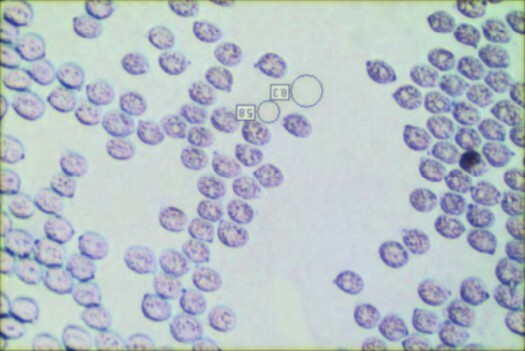
This presentation describes the process of designing a 0.7NA visible digital microscope intended to be used out in the field for identifying mushrooms based on their spores. The microscope would image a 0.356mm field and magnify it by 10x onto an off the shelf digital microscope sensor the AmScope 5.0MP USB 2.0 color Digital Eyepiece. The sensor has a USB port and could be plugged into a phone to view the images of the spores in the field. This magnification will image a 5.8um x 8.3um spore onto a sensor area of 26 x 37 pixels. The 0.7NA allows for resolution of 0.5um features allowing for clear examination of many features used to differentiate spores from different species of mushrooms. The nominal design has an RMS wavefront error of 0.0487 waves making it diffraction limited.
 Marlena Berger
 - Infinity-Corrected Immersion Objective Design for Multiphoton Microscopy of Bread Dough
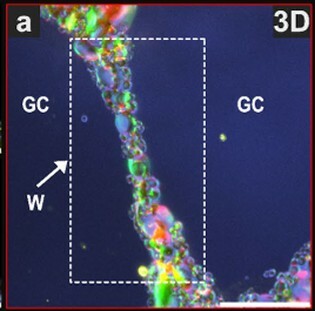
Multiphoton microscopy is a powerful imaging technique. Common in medical imaging applications, it uses nonlinear optical processes to generate signals from excitation wavelengths that are two or three times longer than the collected wavelengths. This presentation explores the use of a multiphoton microscope for the structural analysis of bread dough. Understanding the behavior of gas cells within bread dough is a strong predictor of the quality the bread will have when baked. Starting from an immersed 1.05 NA patent objective for visible light, we walk through the design process to reach a lens that is diffraction-limited across 820 nm - 1240 nm. Topics discussed throughout include how to model immersed images in CODE V, strategies to replace fictitious materials with appropriate glasses, and an appreciation for the sensitivity of high-NA systems.
 Ganesh Petterson
 - A Macro Lens for Ultraviolet Photography of Flowers
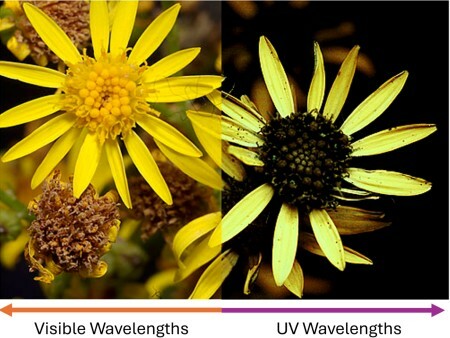
Ultraviolet features in flowers are varied amongst species and are not readily apparent to the human eye. The attached image of common ragwort, for example, depicts the visible-light appearance in the left half, in contrast with the more striking ultraviolet patterning shown in the right half of the image. A camera lens designed for close-conjugate imaging in visible and ultraviolet wavelengths between 315 and 400 nm would enable effective imaging of UV patterns in flowers, along with a comparison to the visible-light appearance, simply by switching out a front filter on the lens. This report details the process of adapting one such UV-capable lens, the UV-Nikkor 105mm F/4.5, to a more modern DSLR sensor, and the resultant improvement in MTF performance. We found that we were able to improve performance at the cost of added complexity in the lens, with the final result requiring tight tolerances to obtain a reasonable yield.
 Isabelle Settle
 - PebbleVision: Visible Camera for Olympic Curling Ice Characterization
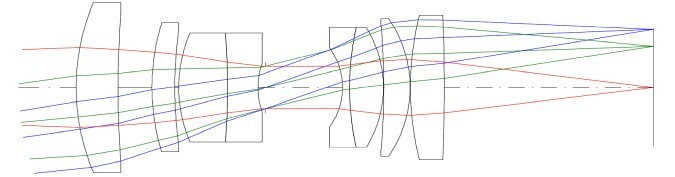
The physics governing why a curling stone moves remains a “mystery of the century” due to the lack of sufficiently precise observational data regarding the stone-to-ice interaction. To address limitations in both curling physics research and ice preparation, a visible camera was designed to enable both data acquisition and ice quality monitoring. An in-depth first-order study was conducted to evaluate the engineering tradeoffs between the spatial resolution required for collecting under-sampled surface scratch data and assessing ice conditions assisting Olympic ice technicians. The design process utilized an initial Double Gauss form that was transferred from infinite to finite conjugates to preserve stability of the design form while satisfying system packaging constraints. A magnification versus performance study was conducted to characterize the limits of the Double Gauss architecture across finite conjugates. The final configuration has a magnification of -0.3, mapping the critical 40µm scratch onto 8 detector pixels while simultaneously capturing approximately 23 pebbles across the field of view for statistical monitoring of ice conditions.